
With this new induction, the country has the capability to launch nukes from land, air and sea.

India has commissioned its new indigenously-built nuclear-powered ballistic missile submarine INS Aridaman into service, further strengthening the naval component of its nuclear triad. Defence Minister Rajnath Singh also highlighted the Indian Navy's role in securing maritime trade routes.

Experts' worries intensified after Pakistan commissioned its first Chinese-built Hangor-class submarine, PNS Hangor, last month.

India is strengthening the naval component of its nuclear triad with Navy Chief Admiral Dinesh K Tripathi on Tuesday saying that the third indigenous nuclear-powered submarine 'Aridaman' will be commissioned soon and that his force is focusing on boosting its overall combat prowess.

Moving towards completing its nuclear triad, India will activate the atomic reactor on-board the indigenous nuclear submarine INS Arihant in the "next two to three weeks" paving way for its operational deployment by the Navy soon.

India's second nuclear-powered ballistic missile submarine was commissioned into the Navy on Thursday in the presence of Defence Minister Rajnath Singh who said this will further strengthen the country's nuclear triad and enhance nuclear deterrence.

In a major step towards completing its nuclear triad, India has activated the atomic reactor on-board the indigenous nuclear submarine INS Arihant, paving the way for its operational deployment by the Indian Navy.

Dhanteras, the prime minister said, has become even more special.

Moving a step closer to completing its nuclear triad, India today successfully test fired a ballistic missile, with a strike range of around 1,500 km, from an underwater platform in Bay of Bengal. "The medium range K-5 ballistic missile was test fired successfully today from an underwater pontoon and all parameters of the test firing were met," said Defence Research and Development Organisation chief V K Saraswat from the undisclosed test area.

China displayed a range of new weapons at a military parade, including laser weapons, nuclear ballistic missiles, giant underwater drones, and fifth-generation aircraft.

China is expected to boost its nuclear arsenal after President Xi Jinping's remarks at the key Congress of the ruling Communist Party in Beijing for the first time that Beijing will establish strong strategic deterrence, experts have said.

Russian President Vladimir Putin on Wednesday monitored drills of the country's strategic nuclear forces involving multiple practice launches of ballistic and cruise missiles, the Kremlin said.

Although the credit for acquiring the technological skill must be given to India's outstanding nuclear scientists, the decision to go nuclear was a political one that entailed clarity of vision, courage and resolve, points out Rup Narayan Das.

Israel's aerial assault on Iran is widely viewed as an act of naked aggression with no basis in international law, carried out unilaterally despite US opposition and aimed at derailing ongoing US-Iran nuclear negotiations, observes Ambassador M K Bhadrakumar.

With this India joins the select group of countries which have a nuclear triad -- capable of delivering nuclear weapons by aircraft, ballistic missiles and submarine launched missiles.
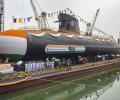
The status of the current submarine force level is alarming and we need to address the threat perceptions expeditiously. Critical decisions pertaining to national security cannot be delayed any further due to the rapidly changing maritime threat perceptions and growing strategic importance of the Indian Ocean region, asserts Commodore Venugopal Menon (retd).
"Arihant is steadily progressing towards its operationalisation and we hope to commence sea trials in the coming months. Given our unequivocal no-first-use commitment -- a retaliatory strike capability that is credible and invulnerable is an imperative. The Indian Navy is poised to complete the triad and our maritime and nuclear doctrines will then be aligned to ensure that our nuclear insurance comes from the sea," Navy chief Admiral Nirmal Verma said
The underwater leg of the nuclear triad has always been regarded as the most survivable. Going by the January 27 test, the K-15 missile is well up to the task. Ajai Shukla reports

With the indigenous nuclear submarine INS Arihant set to be launched for sea trials in few weeks, India will soon complete its nuclear triad giving it the capability to respond to nuclear strikes from sea, land and air-based systems.

China will be the nuclear threat of most concern to New Delhi for at least another decade, the latest report by the Arms Control Association says.
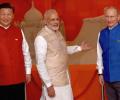
'With Pakistan's 'first use doctrine' threatening the use of nuclear weapons early in a war with India, the S-400 will shield vulnerable targets like Delhi and Mumbai, complicating Pakistan's targeting calculations.'

According to the Pentagon report, the PLA is creating options for dissuading, deterring, and defeating external intervention in the Indo-Pacific region.
India is not converting all its weapons-grade plutonium into war heads, two top American nuclear scientists have claimed, estimating that it currently has 80 to 100 nuclear warheads for its emerging triad of air, land, and sea-based nuclear-capable delivery vehicles.

'Putin is in danger of losing face in his Ukrainian adventure. His bluster is a response to this.'

The National Security Strategy document should flag all major issues concerning security strategy and provide guidelines to concerned departments to work out suitable action plans. Since the global and regional geopolitical canvas is dynamic, the NSS document should be deliberated at length before formulation and should be reviewed periodically, recommends Commodore Venugopal Menon (retd).
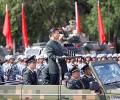
Xi said the entire military should devote all its energy to carry out all its work for combat readiness, enhance its capability to fight and win, and effectively fulfill its missions and tasks

'It is hard to justify $225 million a plane for an increasingly obsolete mission.' The purchase of the 36 Rafales has changed little for the IAF.

'In this regard, the future stability of Pakistan remains a wild card,' said the report.
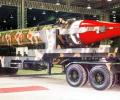
According to the report, Russia tops the table with 6,375 warheads, followed by the United States with 5,800, and the United Kingdom with 215 warheads.

The strategy, President Donald Trump said, is tailored and flexible to address the wide array of threats in the 21st century.
With the launch of the first indigenous aircraft today, India will join a club of nations like the United States, Russia, China, the United Kingdom and France that possess nuclear-powered submarines
India's indigenous nuclear-powered submarine INS Arihant will be ready for deterrent patrols in two years from now, completing the nation's capability to deliver strategic weapons from land, air and undersea.

'With two nuclear neighbours, how likely is it for our armed forces to battle in a contaminated environment that could include nuclear, biological or chemical attacks by the adversary?' 'Are we prepared for the threat?' Brigadier S K Chatterji (retd) explains the meaning and significance of Operation Vijay Prahar.
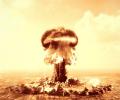
The new government must initiate a comprehensive review of India's nuclear weapons doctrine and posture. Ajai Shukla explains
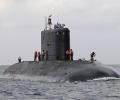
The Bay of Bengal base will house nuclear submarines and aircraft carrier

Rediff.com present a comprehensive listing of the nuclear nations and their collective and active stockpile.

A proposed nuclear deal aims to stop Pakistan from building small tactical nuclear weapons that could fall into terrorist hands.

He asserted that India has never been an aggressor and the Indian Armed Forces are perceived as defenders of humanity and peace across the world.

'All the government needs to do is to identify clear political and strategic objectives and to give the military planners a free hand,' asserts Ajai Shukla.
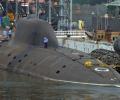
The INS Chakra III will be ideal for 'sea denial' missions, in which the submarine denies the enemy the use of the sea.
